
Why M-Vac
Meat Validations

Beef Safety Monitoring with the M-VacThe M-Vac wet vacuum surface sampling device has numerous applications within food processing facilities. A broad spectrum of validations, including environmental, carcass/primal, and beef trim sampling, have been conducted to determine whether the M-Vac is capable of producing bacterial recoveries equivalent, or better, than currently utilized sampling techniques.Testing showed the M-Vac was able to recover significantly higher (P < 0.05) levels of Listeria and Salmonella from environmental surfaces than sponges and swabs. Simulated carcass surfaces were inoculated and the M-Vac was able to more frequently recover detectable levels of E. coli O157:H7, inoculated at low levels (1 – 5 CFU), than cellulose sponge. Trim testing was conducted in two phases. The first phase was three separate plant staged field trials. Trim was sampled with the M-Vac and excision techniques and no significant differences were found. Phase two of the trim testing was conducted in the laboratory and involved low level (1 – 5 CFU) E. coli O157:H7 inoculated onto pre and post rigor mortis brisket and flank beef. The M-Vac showed recoveries that were not significantly different than excision regardless of the condition of the meat at the time of inoculation. Throughout all three validations the M-Vac was able to produce bacterial recoveries that were either significantly better than or not different than the evaluated conventional methods. These results suggest the M-Vac is a suitable alternative to current sampling techniques for food safety monitoring activities. Read the full report View PDF of Graphs |
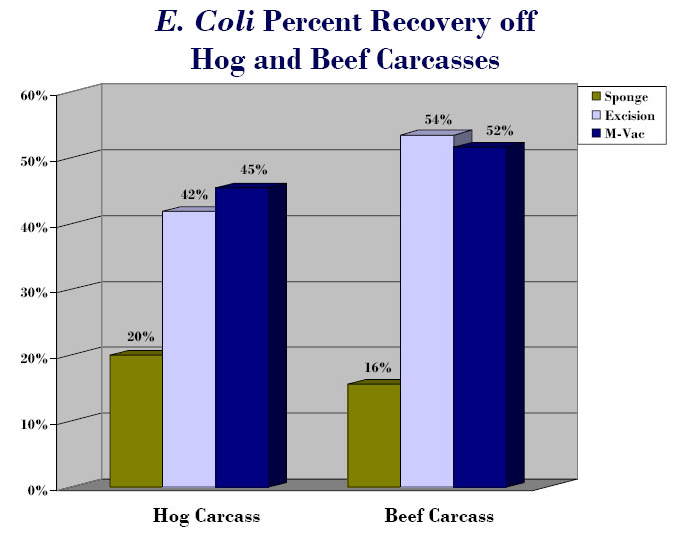
E. Coli Recovery from Hog and Beef CarcassesExcision is considered the gold standard when evaluating surface pathogen sampling methods on soft materials such as meat carcasses. This graph demonstrates the ability of the M-Vac to collect similar levels of E. coli from meat surfaces compared to the excision method, and significantly higher levels than sponges. The M-Vac improves the recovery of pathogens located within surface cracks or crevices typically prevalent on meat and poultry surfaces.View Graph |